

 Posted by
Electricity is one of the most important resources for any manufacturing or industrial business. From operating heavy-duty motors and compressors to running pumps, production machines and HVAC systems, industries depend on a continuous power supply to maintain daily operations. However, consuming electricity efficiently is just as important as having an uninterrupted power supply.
One common challenge faced by industrial facilities is poor power factor. When electrical equipment such as induction motors, transformers and other inductive loads operate, they consume reactive power along with active power. This can increase current demand, create additional losses in the electrical distribution system and sometimes lead to power factor penalties from electricity distribution companies.
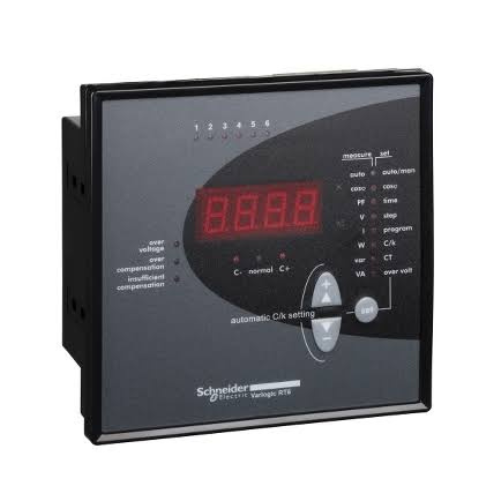
This is where Schneider Electric APFC Controllers become important. These controllers help industries maintain an appropriate power factor by automatically managing capacitor bank switching according to changing electrical load conditions.
Let’s understand why APFC controllers are becoming an essential part of modern industrial electrical systems.
What Is an APFC Controller and How Does It Work?
APFC stands for Automatic Power Factor Correction. An APFC controller is an intelligent electrical device used to monitor the power factor of an electrical installation and automatically control capacitor bank steps to improve it.
In simple terms, when industrial equipment operates, it may require additional reactive power. Capacitor banks provide the required reactive power compensation, helping reduce the amount of reactive power drawn from the electricity supply.
An APFC controller continuously monitors electrical parameters through suitable measurement inputs, typically using a current transformer and voltage connections. Based on the measured power factor, it switches capacitor bank steps ON or OFF as required.
Unlike manually operated capacitor banks, an automatic system responds to changing load conditions without requiring operators to make frequent adjustments.
5 Reasons Why Schneider APFC Controllers Are Essential for Modern Industries
Modern industries experience changing electrical loads throughout the working day. Production machinery may start and stop, compressors may operate intermittently, and different manufacturing sections may consume varying amounts of electricity.
Schneider APFC controllers help manage these changing requirements through automatic power factor correction.
Here are five important advantages:
1. Automatic Power Factor Improvement
Maintaining a healthy power factor is important for industrial electrical installations. Poor power factor can increase the current required to deliver the same amount of active power. Schneider APFC controllers automatically manage capacitor bank operations to maintain the targeted power factor. This helps industries reduce unnecessary reactive power demand and improve the overall efficiency of their electrical distribution system.
2. Helps Reduce Electricity-Related Penalties
Many electricity distribution companies apply additional charges when industrial consumers maintain a power factor below the prescribed limits. These charges can increase monthly electricity expenses. By automatically controlling capacitor bank steps, an appropriately configured APFC system helps industries maintain the required power factor and potentially avoid power factor-related penalties. Actual savings depend on the utility tariff structure and the existing electrical installation.
3. Reduces Unnecessary Current Flow and Distribution Losses
Poor power factor can result in higher current flowing through cables, transformers and other electrical distribution components for the same active power requirement. This can increase resistive losses and place additional demand on electrical infrastructure. By providing reactive power compensation closer to the load, an APFC system can reduce upstream current and associated distribution losses, provided the system is correctly sized and installed.
4. Supports Better Utilisation of Electrical Equipment
Transformers, cables, switchgear and other electrical components have specific current-carrying capacities. When reactive power demand is unnecessarily high, these components may have less available capacity for useful active power. Improving the power factor can release some of this electrical capacity, allowing industries to utilise their existing infrastructure more effectively without immediately requiring additional capacity.
5. Automatic Operation with Changing Industrial Loads
Industrial power requirements are rarely constant. Some machines operate continuously, while others run only during specific production cycles. A fixed capacitor bank may not provide the correct compensation under every operating condition. Schneider APFC controllers automatically switch capacitor steps according to changing load requirements. This helps maintain a more stable power factor and reduces the possibility of overcompensation when the system is configured correctly.
Why Schneider Electric APFC Controllers Are a Preferred Choice
Schneider Electric is a recognised manufacturer of electrical distribution and power management solutions. Its APFC controller range is designed to support automatic reactive power compensation in different electrical installations.
Depending on the selected model, Schneider APFC controllers can offer useful features such as:
- Automatic Capacitor Switching: Controls capacitor bank steps according to changing reactive power requirements.
- Power Factor Monitoring: Helps operators monitor the electrical system’s power factor.
- Flexible Configuration: Supports different capacitor bank arrangements and step configurations.
- System Protection and Alarms: Selected models provide alarm and fault indication features to support maintenance activities.
- Improved Operational Management: Helps reduce the need for frequent manual capacitor bank adjustments.
The exact features, number of steps and communication capabilities depend on the specific controller model.
Where Are Schneider APFC Controllers Used?
APFC controllers are useful in industries where electrical loads create significant reactive power demand.
Some common applications include:
1. Manufacturing Plants: Production machinery, motors, compressors and industrial equipment often create inductive loads that require reactive power compensation.
2. Chemical Industries: Mixing machines, pumps, ventilation systems and other electrically operated equipment can contribute to changing reactive power requirements.
3. Textile Industries: Spinning machines, looms, motors and processing equipment can benefit from properly designed power factor correction systems.
4. Pharmaceutical Industries: Manufacturing and packaging equipment, HVAC systems and utility machinery create electrical loads that need effective power management.
5. Commercial and Industrial Buildings: Central air conditioning, elevators, pumps and other large electrical systems can contribute to poor power factor.
Important Factors to Consider Before Selecting an APFC Controller
Choosing an APFC controller requires more than simply checking its brand or price. The controller must match the electrical requirements of the installation.
Here are some important points to consider:
- Electrical Load Requirements: Understand the existing power factor and reactive power demand.
- Number of Capacitor Steps: Select a controller that supports the required capacitor bank configuration.
- Operating Voltage: Check compatibility with the electrical system.
- Current Transformer Ratio: Ensure correct CT selection and configuration for accurate measurements.
- Harmonic Distortion: Industries with VFDs, UPS systems and other nonlinear loads should assess harmonic levels before installing capacitor banks. Detuned reactors or specialised harmonic mitigation solutions may be necessary.
- Future Expansion: Consider potential increases in production capacity and electrical load.
Professional electrical assessment is recommended before designing or upgrading an APFC panel.
How APFC Controllers Contribute to Long-Term Industrial Savings
For industrial businesses, electricity expenses represent a significant part of operational costs. Improving power factor can help reduce reactive power-related charges, minimise avoidable distribution losses and make better use of existing electrical infrastructure.
However, it is important to understand that an APFC controller does not directly reduce the active energy consumed by machines. Its main function is to manage reactive power compensation. The actual financial benefits depend on the electricity tariff, load profile, existing power factor, capacitor bank design and operating conditions.
A properly designed APFC system can therefore become a valuable investment in long-term electrical management.
Final Thoughts
Modern industries need electrical systems that are efficient, reliable and capable of handling changing production requirements. Poor power factor can create unnecessary pressure on electrical infrastructure and increase electricity-related expenses.
Schneider APFC Controllers help industries address this challenge through automatic capacitor bank management and continuous power factor monitoring. When integrated into a correctly designed APFC panel, they support better reactive power management, improved electrical capacity utilisation and reduced avoidable distribution losses.
For industries planning to upgrade their electrical infrastructure, investing in a suitable Schneider APFC controller is a practical step towards smarter power management and more efficient industrial operations. How LAPP Cables Support Continuous Production in Manufacturing Industries